Fast, Reliable ADU Builders Across Morongo Valley
Building an ADU in Morongo Valley starts with one question most contractors skip: has the county signed off on your septic and well plan? On a half-acre lot without municipal water or sewer, that approval is the real gate for your project. We know because we’ve walked that path on parcels along the east side of Highway 62, where the seasonal wash sets the boundary for everything you can build. If you’re researching ADU Builders who understand Morongo Valley’s specific county review process, call us at (877) 265-5812. We’ll walk your property, check the setbacks, and give you a straight answer about what’s buildable.
Why Orange ADU Builders Is Morongo Valley’s Preferred ADU Builders Company
Our work in Morongo Valley centers on the unincorporated San Bernardino County process, which is different from what you’d face in Yucca Valley or Palm Springs. We’re familiar with the county’s septic permitting requirements, the well yield verification, and the setback rules from the seasonal wash on the east side of Highway 62. That local knowledge keeps your project moving instead of stalling in review.
Homeowners here ask us to compare prefab systems against site-built options, and we do that without pushing one vendor. We work with Abodu, Cover, and James Hardie exterior products, which means you can weigh delivery timelines, panel quality, and wind ratings side by side. Nelson Ybarra built Orange ADU Builders around exactly this kind of honest comparison, because an ADU in Morongo Valley has to hold up to freeze-and-thaw cycles, 100°F summers, and the strong winds that tunnel through the Morongo Basin pass.
The response time to Morongo Valley from our Orange headquarters is straightforward: we schedule site visits within a week, and we’ll tell you upfront if the county review will add time. No vague timelines, no surprises after you’ve signed.
Detached ADU in Morongo Valley
A Detached ADU in Morongo Valley is a standalone unit on your existing lot, and on most 1950s – 1980s ranch or cabin-style parcels it’s the only path that makes sense. You’ll need a separate septic system or a county-approved connection plan, plus a verified well yield before design starts. We handle that pre-design legwork because it determines where the ADU can physically sit, especially when the seasonal wash runs through or along your parcel.
Expect to budget $180,000 – $320,000 for a detached unit here, depending on size, finishes, and what the septic upgrade requires. If the county demands a new leach field or a larger holding tank, that cost lands inside the range we quote you, not as a surprise change order.
Wind-Rated Roof and Siding
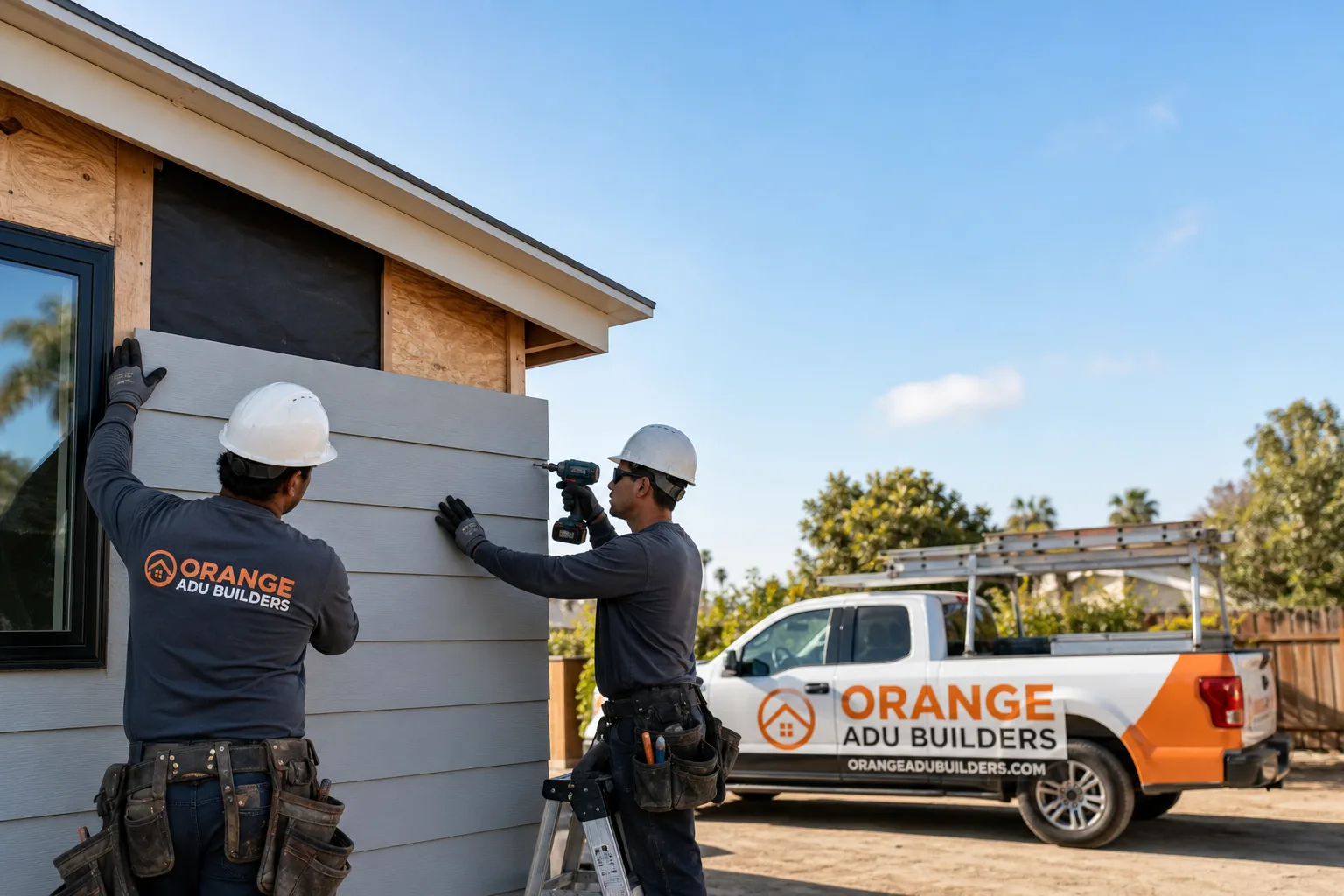
The Morongo Basin pass funnels wind hard through Morongo Valley, so a detached ADU needs a roof assembly and siding that carry documented wind ratings. Standard residential assemblies often don’t meet what San Bernardino County wants for this elevation. We specify James Hardie fiber-cement siding and a roof system sized for the local gusts, then put those product data sheets in your permit packet.
Septic and Well Coordination
Our site visit includes measuring the septic setback from the seasonal wash east of Highway 62, because that dry creek bed becomes a flash-flood channel during monsoon storms. The county will reject a design that ignores it. We also verify well yield early, since a weak well can cap the size of your ADU before you spend a dollar on plans.
JADU in Morongo Valley
A JADU in Morongo Valley converts existing space inside your ranch-style or cabin-style home into a smaller accessory unit, which can be a smarter move when your parcel’s septic capacity is already maxed out. Because a JADU stays within the main home’s footprint, it may not trigger the same county septic expansion that a detached unit would. That’s a meaningful advantage on older lots with original systems.
JADU projects in Morongo Valley typically run $80,000 – $140,000 for a complete conversion of 400 – 600 square feet. The range depends on whether you need a separate entrance, a kitchen, and how much of your existing plumbing and electrical we can reuse.
Attached but Independent
You get a rental-ready space with its own entry, kitchenette, and bath, but you share the main home’s septic and water lines. The county still reviews the conversion, but the scope is smaller. That means faster permit approval in 92256 and less trenching across your yard.
Freeze-Protected Plumbing
Morongo Valley drops below freezing in winter, and cabin-style homes from the 1960s were rarely built with insulated plumbing runs. When we convert a JADU, we spec freeze protection on any exposed or exterior wall runs. It’s a small line item that prevents a burst pipe the first cold snap.
Trusted Brands We Service in Morongo Valley
Our team works with prefab systems from Abodu and Cover, plus Tuff Shed structures for budget-conscious studio builds, and we finish exteriors with James Hardie siding. That range matters in Morongo Valley because one brand’s standard panel size may not clear your county-mandated septic setback, while another’s does. We keep material lead times current for 92256 deliveries, and we can usually get a prefab unit on-site within 8 – 14 weeks, depending on the manufacturer’s queue. If a Tuff Shed-style structure won’t meet the wind rating your parcel needs, we’ll tell you before you order it.
Common ADU Builders Problems We See in Morongo Valley Homes
- Quoting before septic and well review. A builder gives you a price, then the county says the septic drain field doesn’t have the required setback from the seasonal wash. The design has to move, and the budget jumps.
- Standard roof and siding specs that won’t pass wind review. Assemblies rated for coastal or low-desert conditions get flagged when the Morongo Basin pass wind loads are applied. The permit stalls, and the owner pays for re-engineering.
- Unprotected plumbing in a 2,500-foot climate. A JADU or detached unit built without freeze protection on lines near exterior walls blows a pipe in January. The repair rips open finished walls.
- Ignoring the seasonal wash on the east side of Highway 62. That dry creek bed floods during monsoon storms, and any structure placed inside the county’s setback gets a stop-work order or a failed final inspection.
Pricing for ADU Builders in Morongo Valley, CA
A JADU conversion in Morongo Valley runs $80,000 – $140,000. A detached ADU on a standard half-acre lot runs $180,000 – $320,000. The wide range comes down to three things: what your septic system needs, which prefab brand or site-built approach you choose, and whether the county requires wind-rated structural upgrades beyond the base spec. Our quotes are line-itemed so you can see the septic work, the structure, the siding, and the plumbing separately. Call (877) 265-5812 for a free estimate. We’ll walk your parcel, verify the setbacks, and give you a fixed number with no change orders after the county review.
We Also Serve Cities Near Morongo Valley
Beyond Morongo Valley, we take ADU projects in Desert Edge, Garnet, Desert Hot Springs, and Yucca Valley. Each has its own water, sewer, and wind nuances. Read more about our Morongo Valley coverage or call us directly at (877) 265-5812 to talk through your specific lot.
Serving Morongo Valley, CA — Our Local Coverage Area
We’re based in the Morongo Valley area and know this community well. Use the map below to see our service coverage — if you’re nearby, we can almost certainly help.
FAQs About ADU Builders in Morongo Valley
An ADU roof in Morongo Valley needs a wind rating that matches the Morongo Basin pass’s exposure, which typically falls into Exposure C territory for engineered assemblies. That means uplift-rated roof-to-wall connections, a continuous load path, and manufacturer data sheets that document the rating. A compliant quote includes those calculations and products. Call (877) 265-5812 and we’ll review what your parcel requires.
Because Morongo Valley is unincorporated San Bernardino County, your property operates on a private septic system and well, not municipal water and sewer. Yucca Valley lots connect to a sewer district. The county has to confirm your septic can handle an ADU’s added load and that your well yields enough water. If either fails, the ADU’s size or placement changes. We check both before design, so you aren’t paying for plans the county will reject.
Documented compliance with wind, freeze, and flood-related code requirements gives your insurer proof the structure was built to local standards. If you have a wind or freeze claim later, the permit packet with engineering calcs and sign-offs supports your claim and can affect your premium. A cheap bid that skips those documents leaves you defending a claim without evidence. We hand every Morongo Valley owner a complete inspection packet at closeout.
At 2,500 – 3,000 feet, your ADU needs wall and ceiling insulation that handles both 100°F summers and winter frosts, typically R-21 walls and R-38 ceilings or better depending on the assembly. Plumbing on exterior walls or in crawl spaces needs freeze protection. These specs are standard in our Morongo Valley quotes and get documented for inspection.
Yes, and a JADU is often the faster, more affordable path in Morongo Valley because it stays inside your home’s existing footprint and may avoid triggering a septic capacity review. We can assess your floor plan, check the county’s JADU standards for 92256, and give you a buildable scope. Call (877) 265-5812 to schedule a walkthrough.
Ready to get a real number for your Morongo Valley ADU? Call (877) 265-5812 for a free, line-itemed estimate. We’ll verify your septic setback, check your well yield, and spec the wind and freeze ratings your parcel requires. No vague numbers, no county surprises.
Written by Nelson Ybarra, Owner at Orange ADU Builders, serving Morongo Valley since the company’s founding.