Cover ADU Builders in Orange: A Homeowner’s Guide
If you’re comparing Cover ADU builders in Orange, here’s the straight answer: Cover builds a well-engineered prefab ADU with a clean, modern look and predictable pricing, but it’s one option among several strong systems. The real decision isn’t which brand name is on the unit. It’s who manages the permit, the foundation, the utility tie-ins, and the punch list after the factory delivers. If you’d rather not sort through all of that yourself, call (877) 265-5812 and we’ll walk you through it.
Here’s the thing most homeowners don’t realize until they’re three months into a stalled project: there are dozens of contractors in Orange who will happily take your ADU deposit. There are far fewer who have pulled an ADU permit in Riverside County in the last 18 months, finished on the schedule they quoted, and can show you a finished unit you can walk through. That gap is what this guide is about.
What “Cover ADU Builder” Actually Means in Orange
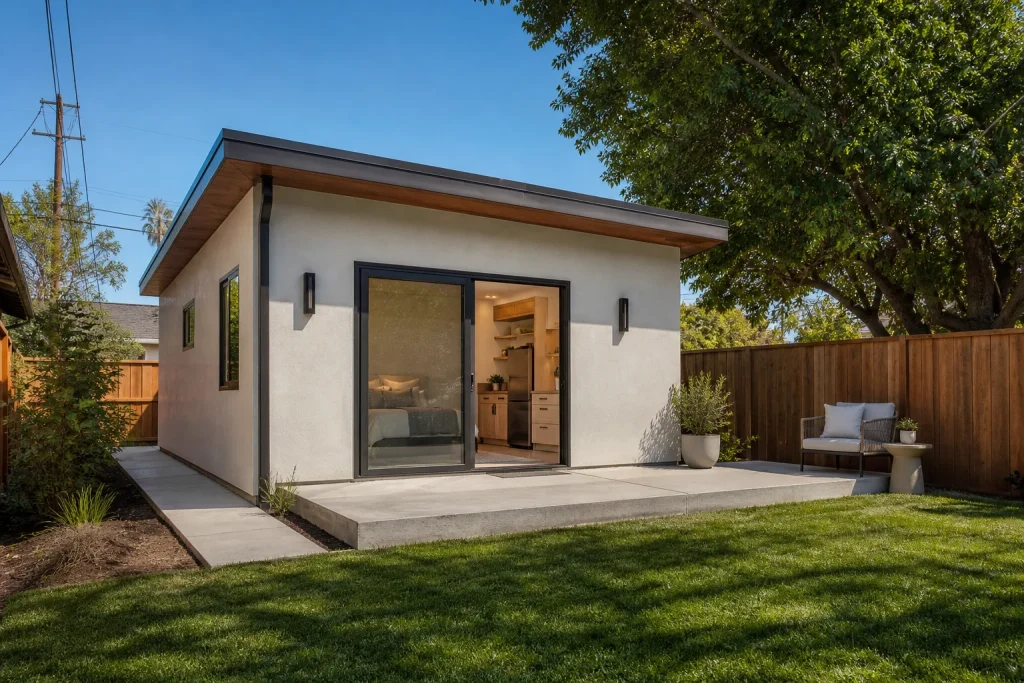
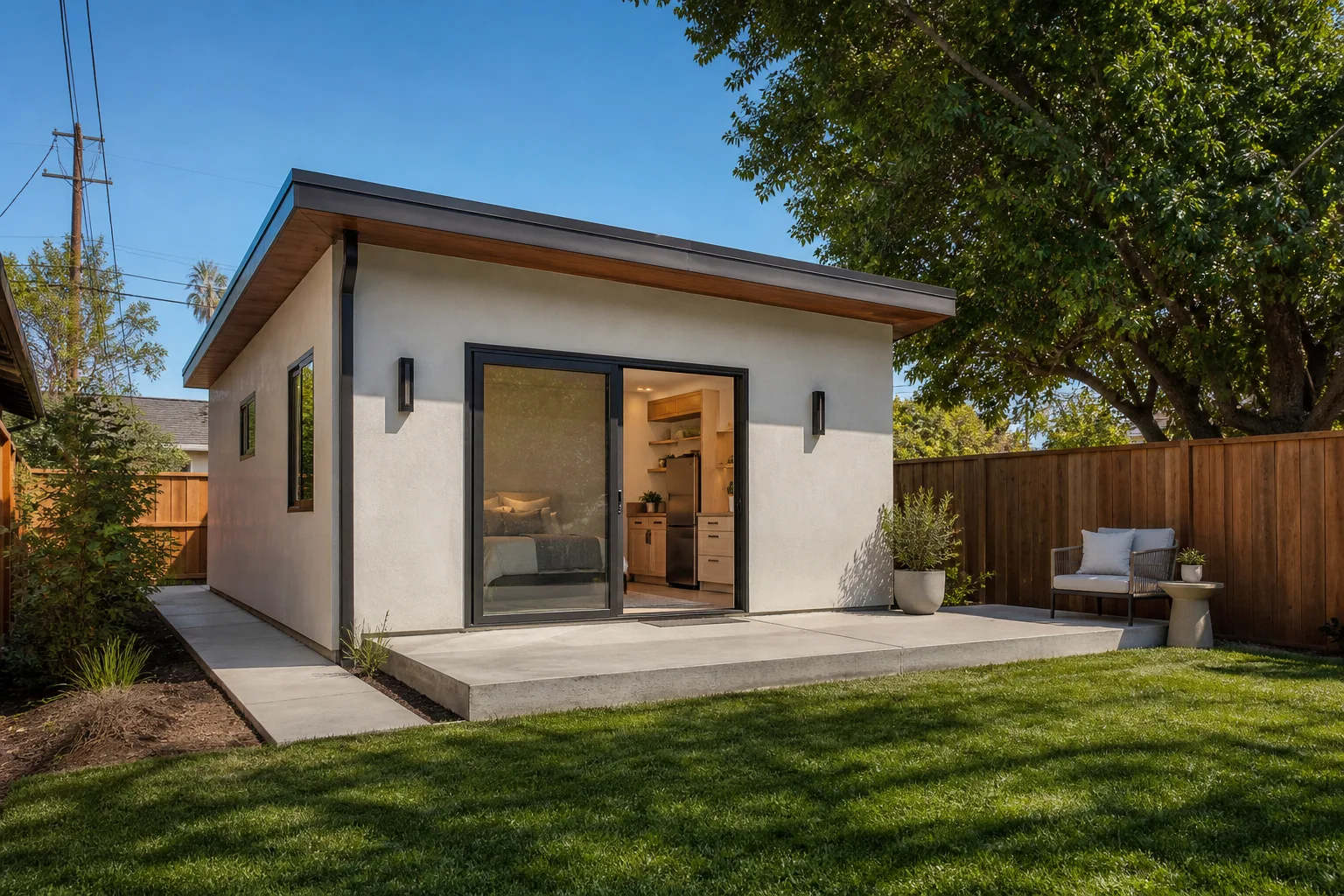
Cover is a Los Angeles-based prefab manufacturer that builds panelized ADUs in a factory and ships them flat-packed to your site. A Cover unit arrives as precision-cut wall panels, floor cassettes, and roof sections that a local crew assembles on your foundation. The finish quality is genuinely high: clean lines, floor-to-ceiling windows, integrated lighting. In Orange’s climate, the materials hold up well because we don’t deal with freeze-thaw cycles, though inland heat does put real stress on any unit’s insulation and HVAC sizing.
But here’s the distinction that matters: Cover manufactures the building system. They don’t sit in your Orange planning department meeting, they don’t coordinate with Southern California Edison on your utility drop, and they don’t schedule the Riverside County building inspector. That work falls to whoever you hire as the local builder. Some companies that advertise as “Cover ADU builders” are really just order-takers who pass your project to a third-party installer. Others, like us, handle the full site work: foundation, panel assembly, utility connections, interior finishes, and final inspection sign-off. Ask any builder you’re considering: “Who pulls the permit, and whose name is on the contract?” The answer separates the real builders from the middlemen.
How Orange and Riverside County’s Permitting Environment Shapes Your Builder Choice
If you’re building in Orange, you’re navigating a specific planning and building department with its own plan check quirks. Riverside County has updated its ADU ordinance repeatedly over the last several years to comply with state law, but local agencies still have discretion on things like setback interpretations, fire sprinkler requirements, and how they handle utility easements. A builder who last pulled an ADU permit three years ago in another county may not know that Orange’s current plan check expects certain details that other jurisdictions wave through.
This is where the “method flexibility” conversation gets real. A prefab-only dealer who sells one brand is going to push that brand through the permit process whether or not it actually fits your lot’s constraints. A design-build general contractor who also does kitchens and bathrooms may not have pulled an ADU permit in six months. What you want is someone who lives in the ADU-specific permit cycle in Orange: someone who knows what the current plan check turnaround looks like, which details trigger comments, and how to handle a correction without blowing the timeline. In our experience, that knowledge is worth more than a lower base price on a prefab unit, because the cost of a stalled permit is measured in months, not dollars.
- Ask the builder: “How many ADU permits have you pulled in Orange in the last 18 months?”
- Ask the builder: “What’s the current plan check turnaround you’re seeing, and what’s the most common correction?”
- Ask the builder: “Who handles the fire sprinkler review and the utility connection coordination?”
Comparing Cover to Other Prefab Systems: What Actually Differs
When a homeowner asks us to compare Cover against something like Plant Prefab or Boxabl, we start with the same framework: how is the structure delivered, how is it assembled, and what does the finished envelope look like in Orange’s climate. Cover’s panelized system ships more efficiently than full volumetric modules, which matters if your Orange lot has tight access or overhead clearance issues. Panelized construction also allows for wider design flexibility than a fully modular Boxabl-style unit, which arrives as a fixed-dimension box.
But the tradeoff is assembly time and on-site labor quality. A panelized system is only as good as the crew that puts it together. We’ve seen panelized ADUs assembled beautifully in Orange backyards, and we’ve seen the same brand assembled with gaps that haunt the owner for years. That’s why we train our crews on specific brands, including Cover, and why we use James Hardie exterior products on site-built work where fiber-cement durability makes sense. A prefab panel with a factory finish is one thing; the flashing, the sealants, and the way the roof ties into the main house are all field work. That’s where the builder’s skill lives.
One more point on this: the prefab brand is not the builder. Cover, Plant Prefab, Boxabl, Dvele, Mighty Buildings, Abodu – these are all systems with real strengths and real limitations. A builder who tells you one system is universally “the best” is either selling you something or hasn’t built enough to know better. The honest answer is that the right system depends on your lot, your budget, your timeline, and how you plan to use the unit. We work across multiple brands so you can compare them side-by-side, not just accept one vendor’s pitch.
The Four Questions to Ask a Builder’s References That Actually Reveal Something
Most homeowners ask a reference, “Were you happy with them?” That’s a feel-good question that tells you almost nothing. Happy is subjective. On-time is objective. Here are the four questions we tell homeowners in Orange to ask when they call a builder’s past clients:
- “What was your original completion date, and when did you actually get your certificate of occupancy?” This is the single most revealing question. Listen for the gap. A three-week slip is normal. A four-month slip is a pattern.
- “Who showed up to manage the site?” Some companies sell you on a project manager and then hand you a rotating cast of subs. Ask if the same person was on-site from foundation to finish.
- “What did the final price end up being compared to the original quote?” Change orders happen. But if the final price was 20% over the original quote without the homeowner adding scope, that’s a red flag about the original estimate.
- “Did anything come up after move-in that required the builder to come back? How did that go?” Every construction project has a punch list. What you want to know is whether the builder answered the phone after the final check cleared.
We pulled a unit out of a garage over in Old Towne Orange last week where the homeowner had already fired one builder. The first contractor had quoted a number that didn’t include the panel upgrade, and when the utility company flagged it mid-project, the “unexpected” cost appeared. That’s not a utility company problem. That’s a builder who didn’t do the site assessment properly. The homeowner called us, we pulled the right permits, coordinated the panel upgrade with the utility, and the project is back on schedule. The lesson: references and site assessments are where the real builder quality shows up.
What “Full-Service ADU Builder” Actually Means: Three Different Models in Orange
Every ADU company in Orange uses some version of the phrase “full-service.” Rarely does it mean the same thing twice. Here’s the breakdown of what you’re actually choosing between:
Design-build under one roof. This is the model where the same company designs, permits, and builds your ADU. One contract, one point of contact, one throat to choke if something goes wrong. The tradeoff is usually price: design-build firms carry more overhead, and you’re paying for the convenience of not coordinating a designer, an architect, and a builder separately.
General contractor managing separate subs. This model has a GC who pulls the permit and then subs out the foundation, framing, electrical, plumbing, and finishes. The GC’s skill is scheduling and quality control. Some GCs are excellent at this. Some are excellent at selling you the job and then disappearing until the final invoice. If you go this route, ask who the project manager is and how often they’ll be on-site.
Prefab dealer with a preferred installer. This model sells you a specific brand (like Cover, Dvele, or Boxabl) and has a relationship with a local installer who does the site work. The dealer’s loyalty is to the brand; the installer’s loyalty is to the next job. If something goes wrong between the factory and the foundation, you may find yourself in the gap between two companies pointing fingers at each other.
At Orange ADU Builders, we operate in the first category with elements of the third: we’re an ADU-dedicated company, not a general contractor moonlighting in ADUs, but we work across multiple prefab brands including Cover. That means we can compare systems honestly because we’re not married to any single one. We also handle kitchen remodeling in Nuevo and bathroom remodeling in Nuevo, which matters when you want to coordinate a main-house upgrade alongside your ADU build without juggling multiple contractors.
The Coverage Gaps Orange Homeowners Don’t Know to Ask About
Here are the three things that typically fall through the cracks in an ADU project, and the questions to ask before you sign anything:
Utility connections. Who pulls the electrical permit? Who coordinates the gas line extension, the sewer lateral, the water meter upgrade? In Orange, some of these touch the city or county and some touch Southern California Edison or SoCalGas. If your builder says “that’s not our scope,” find out whose scope it is before you start.
Post-occupancy corrections. After your certificate of occupancy is issued, builders are required to address certain items. What happens if a window leak shows up in the first rainy season? What if the heat pump underperforms in August? Ask what the warranty covers, for how long, and who actually does the warranty work. A prefab manufacturer’s warranty is only as good as the builder who installs the unit, because the manufacturer will usually blame installation if something fails.
Permit close-out. Some builders get you to final inspection and then move on. But the project isn’t truly done until all trade permits are closed, the final inspection is recorded, and the county has issued the certificate of occupancy. Ask: “Who handles the close-out paperwork, and how long does it take?”
Related services in Orange: if you’re investing in an ADU, it’s often the right time to address the main house too. Learn more about our ADU builders in Nuevo coverage or explore Orange ADU Builders home resources.
When to Call a Pro
If you’re still in the research phase, the best next step is a free estimate that includes a site walk. A builder who shows up, walks your lot, checks your setbacks, looks at your existing electrical panel, and asks about your goals before quoting a price is a builder worth keeping. A builder who quotes over the phone without seeing the site is guessing. ADUs have too many site-specific variables for a phone quote to mean anything: slope, access, utility locations, existing structures, tree protection zones. Call (877) 265-5812 and we’ll schedule a walk-through. It costs nothing and you’ll learn more in an hour than you will in weeks of online research.
The Bottom Line
Cover builds a strong prefab ADU, and in Orange it’s a viable option for a lot of homeowners. But the brand on the panels matters less than the builder who assembles them, permits them, and stands behind them. Filter for actual ADU specialization, local permit track record, and method flexibility. Ask the reference questions that reveal real performance. And understand what “full-service” means in your contract.
If you’re in Orange and want to compare Cover against other systems, Orange ADU Builders offers free estimates and honest advice. Call (877) 265-5812.
Frequently Asked Questions
A Cover ADU in Orange County typically lands between $250,000 and $450,000 all-in, depending on unit size, site conditions, utility upgrades, and finish level. The factory price is only part of the picture; foundation work, permit fees, utility connections, and interior finishes add significantly. Call (877) 265-5812 for a site-specific estimate based on your lot and scope.
From permit submittal to certificate of occupancy, expect 10 to 16 months in Orange, with the factory portion being only a fraction of that. Permit review, foundation work, panel assembly, utility coordination, and final inspections drive most of the timeline. Prefab systems like Cover can compress site assembly compared to traditional site-built construction, but the permit and utility processes remain the gating factors.
Neither is universally better. Cover offers factory quality control, predictable assembly, and a modern design language. Site-built offers maximum design flexibility for irregular lots, height restrictions, or unique program needs. The right choice depends on your specific lot, your budget, and how you plan to use the unit. A builder who works across both methods can give you an honest comparison rather than a pitch.
Yes. The prefab manufacturer builds the structure; a local builder handles the foundation, the permit, the utility connections, and the assembly. Orange’s specific permit requirements, utility coordination, and site conditions require someone who works in this jurisdiction regularly. Choosing a local ADU specialist is the difference between a smooth project and one that stalls at plan check.
Written by the team at Orange ADU Builders, serving Orange since 2013.
Need ADU Help?
Call Orange ADU Builders — licensed & insured, here with fast after-hours help in Orange.
(877) 265-5812